Start with your destinations, not a single idea of “Europe”
A trip built around football can cross several borders in a week: a flight into one city, a train to an away match and a night elsewhere before heading home. Do not assume the same plug will fit every stop. Much of continental Europe uses sockets that accept the two round pins of a Type C plug, often alongside grounded Type E or F arrangements. The UK and Ireland commonly use Type G, with three rectangular pins. Italy and Switzerland have their own common socket types, L and J respectively.
Make a short list of the countries where you will actually charge your devices, including overnight stops. Then check the socket types for each one before buying an adapter. A product described as a “Europe adapter” may cover many continental destinations while excluding the UK, Ireland or a particular grounded socket. Check the adapter’s stated compatibility rather than relying on its name or shape in a photograph.
Know what an adapter does—and what it does not
A plug adapter changes how a plug fits into a wall socket. A basic adapter does not change the voltage coming from that socket. Most European destinations use mains electricity around 230 volts at 50 hertz, but you should check the destination and, more importantly, the rating printed on each device or its power supply.
Look for an input label on a phone charger, laptop power brick or camera charger. If it says “100–240V, 50/60Hz,” the charger is designed to accept that range; you normally need only a suitable plug adapter or compatible power cord. Check the charger rather than the phone or camera it powers. A device marked only for 110–120V should not be plugged into a higher-voltage socket through a simple adapter. It would need appropriately rated voltage conversion, and leaving it at home may be the easier option.
Take particular care with hair dryers, straighteners and other high-power appliances. Some have a dual-voltage switch that must be set correctly before use; others do not support a second voltage at all. Even where voltage matches, the adapter must be rated for the appliance’s power. Accommodation-provided appliances can spare you a bulky item and a potentially awkward electrical setup.
Choose a charging setup that travels well
For most supporters, the essential charging kit is modest: a suitable adapter, the chargers for devices you will use, their cables and a charged power bank. A multi-port USB charger can reduce the number of wall sockets you need, provided its input rating suits the destination and its output suits your devices. Check cables before leaving; a USB-C socket, for example, is not useful if the cable you packed has a different connector.
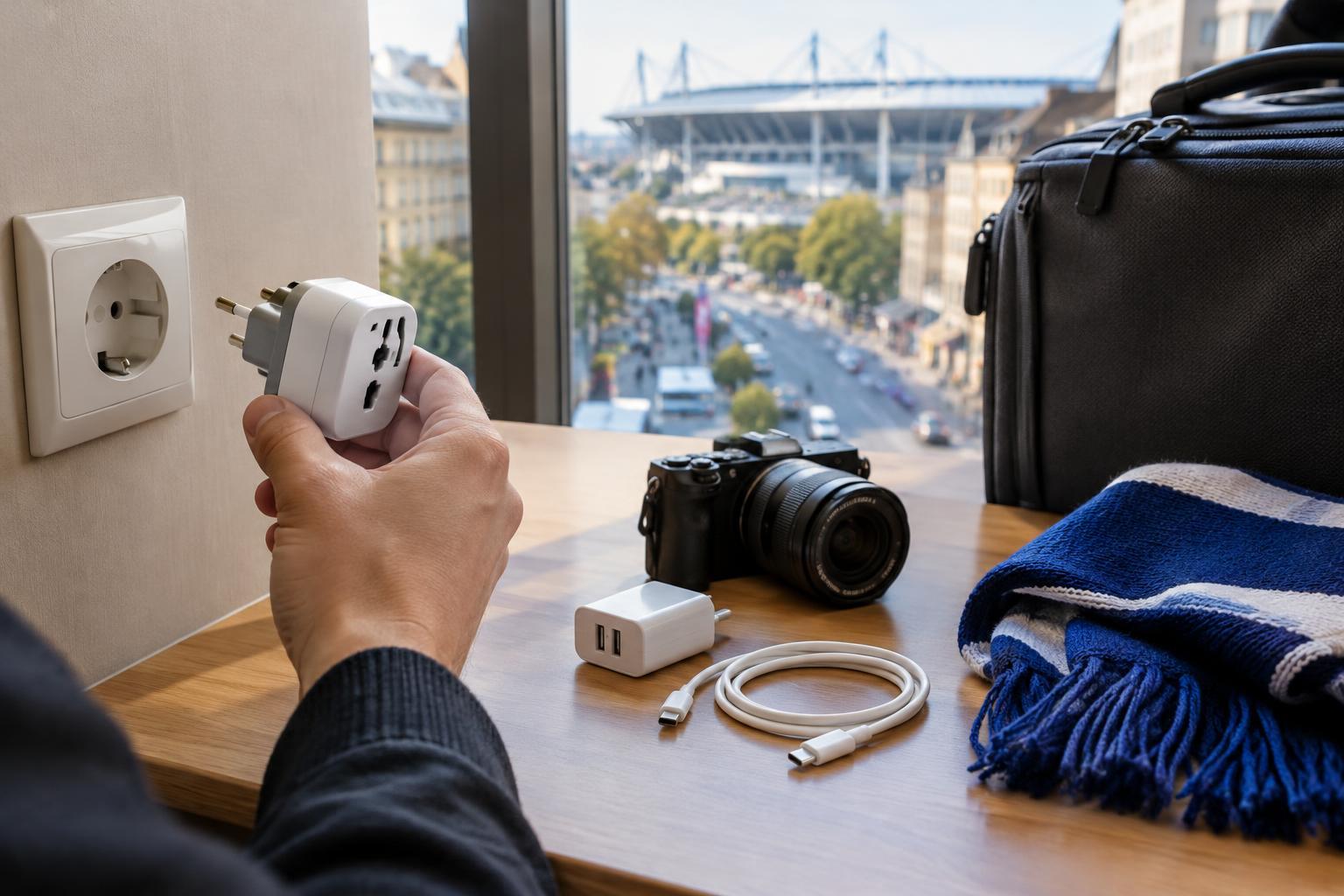
A universal travel adapter can be convenient on a multi-country route, but examine its markings and instructions. Check which plug types it supports, its electrical rating and whether it provides the grounding required by any equipment you plan to connect. Do not force a plug into a loose connection or stack adapters to make an uncertain fit. Grounded appliances should be used only with a setup that maintains the appropriate ground connection.
Consider where charging will happen. A bedside outlet at your accommodation may be more dependable than finding one at a station or near a stadium. Charge your phone and power bank before setting out for the match, especially if you rely on your phone for directions or travel bookings. Venue rules can limit what you bring inside, so check the stadium’s guidance before putting a large power bank or extra equipment in your match-day bag.
Do a two-minute check before you leave
Lay out every item that needs mains power and read its input label. Match each destination to the appropriate socket adapter, then confirm that the adapter’s rating covers the charger or appliance you intend to use. Test the fit of your own plugs in the adapter at home, without assuming that a successful fit proves voltage compatibility.
Finally, pack the adapter somewhere accessible on arrival, alongside the charging cable you will need first. Keep any small detachable plug heads together so they do not vanish into a suitcase. This quick check will not plan your whole football trip, but it can help you arrive with enough charge to find your accommodation, navigate the city and enjoy the match without worrying about an incompatible socket.