A draw was not always the end of the story
Today, supporters watching a knockout match usually know what will happen if the teams remain level: extra time may follow, then a penalty shootout. Earlier European competitions offered no single, dependable script. The way a tie was settled depended on the tournament, the round and the rules in force that season. A draw might mean another match, a calculation across two legs or, occasionally, a decision made without another kick of the ball.
That uncertainty was part of the experience for travelling supporters. A trip planned around one match could turn into a longer stay if a replay was needed. In a two-legged tie, the result in one city might not make sense until the return fixture hundreds of miles away. Understanding those older formats makes historic scorelines more revealing: “drawn” did not necessarily mean “unfinished,” and “won the tie” did not always mean winning the last match.
Replays gave teams another match
A replay was a straightforward answer to a difficult question: if the teams could not be separated, let them play again. It offered a fresh contest rather than asking a brief sequence of kicks to decide the outcome. But it also required a venue, officials, travel and room in both teams’ schedules. For supporters, it could bring another memorable occasion—or an expensive, impractical journey at short notice.
The 1968 European Championship final is a striking example. Italy and Yugoslavia drew their first match after extra time. Instead of going to penalties, they met again in a replay, which Italy won. The replay belongs to the story of that title: the final was not one evening’s contest but two matches, with a chance for both sides to regroup between them.
Two legs, aggregate scores and away goals
Many European club ties used a home-and-away format. The scores from both matches were added together, so a defeat in the first leg did not necessarily mean elimination. A team might lose 2–1 away, win 1–0 at home and finish level at 2–2 on aggregate. The question then became which tiebreaker the competition’s rules specified.
One answer, introduced in some competitions, was the away-goals rule. In the example above, the team that scored in its away match would advance because it had scored more goals away from home. An away goal was not literally worth two goals; it mattered only when the aggregate scores were level. The rule gave the location of each goal unusual importance and could change how teams approached both legs, although its effect on tactics was never entirely predictable.
Extra time could also be used after a level aggregate score, with the next step varying by competition and era. That is why an old European result is best read alongside its format. The scores alone may not explain why a particular team advanced.
When chance made the decision
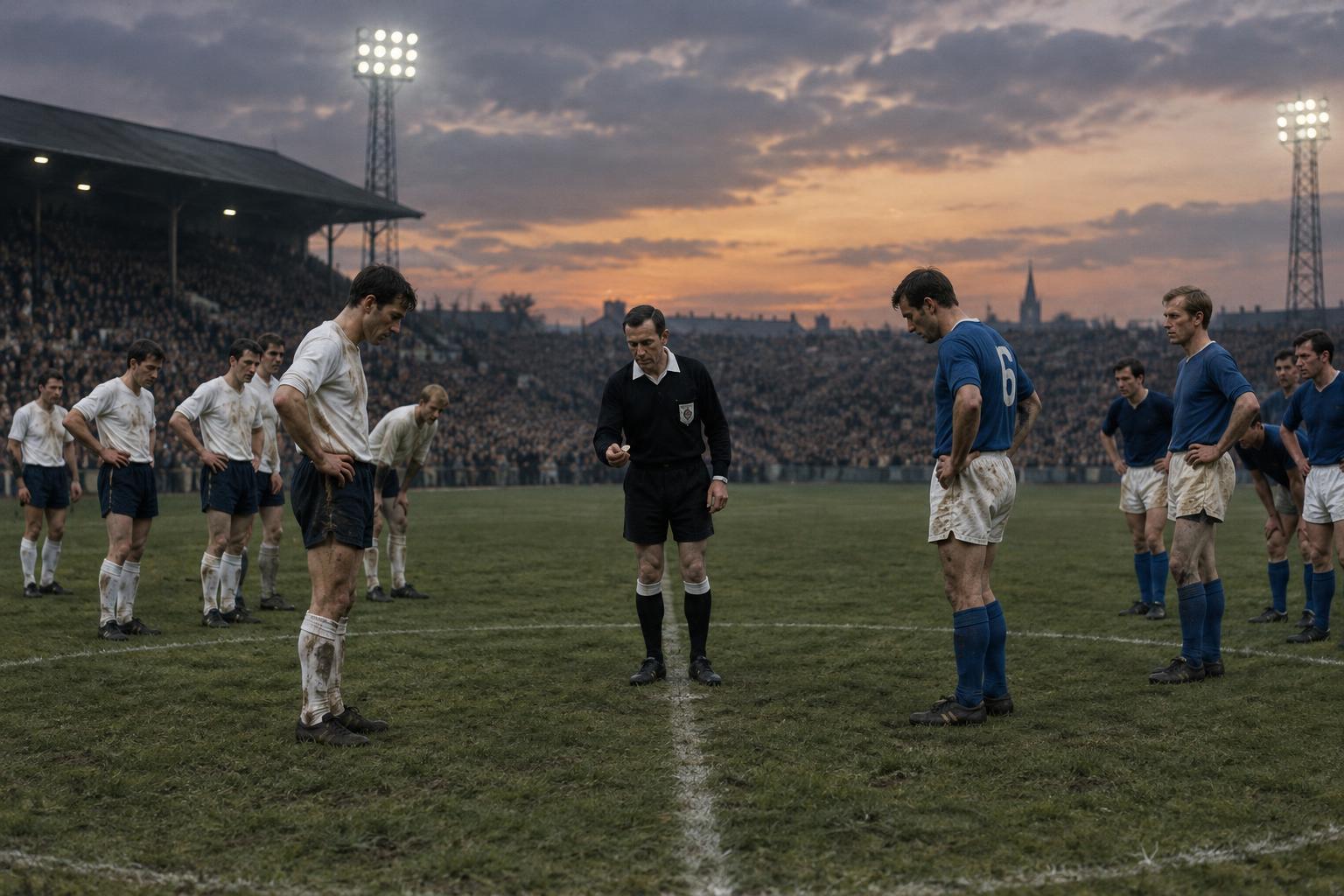
Before shootouts became an established solution, some competitions allowed a draw of lots to settle an unresolved tie. A coin toss is the best-known version. It ended the contest promptly, but left progression to chance rather than another display of football skill. It is easy to see why such a result could feel especially harsh to the losing side.
The 1968 European Championship provides an example here too. Italy’s semi-final against the Soviet Union ended goalless after extra time, and Italy advanced on a coin toss. Their subsequent final required a replay. Within the same tournament, then, two different solutions helped determine the champion. That contrast is a reminder not to assume that one historical rule applied to every match.
Why shootouts changed the experience
Penalty shootouts offered a way to reach a result on the day, on the pitch, without arranging another fixture or leaving the decision to chance alone. They did not remove luck, pressure or debate. They did, however, give both teams the same defined procedure and give supporters a clearer sense of how a tied match would conclude. The 1976 European Championship final, won by Czechoslovakia against West Germany on penalties, showed how dramatic that procedure could be on a major stage.
Replays and draws of lots now feel distant from the usual knockout-match experience, but they reveal the practical problem tournament organisers faced: a competition must eventually produce a winner. Each solution balanced sporting fairness against time, travel and the need for a workable schedule. For anyone exploring European football history, the tiebreaker is more than a footnote. It shaped what players had to do next—and what supporters had to plan for.