A short route to a small final stage
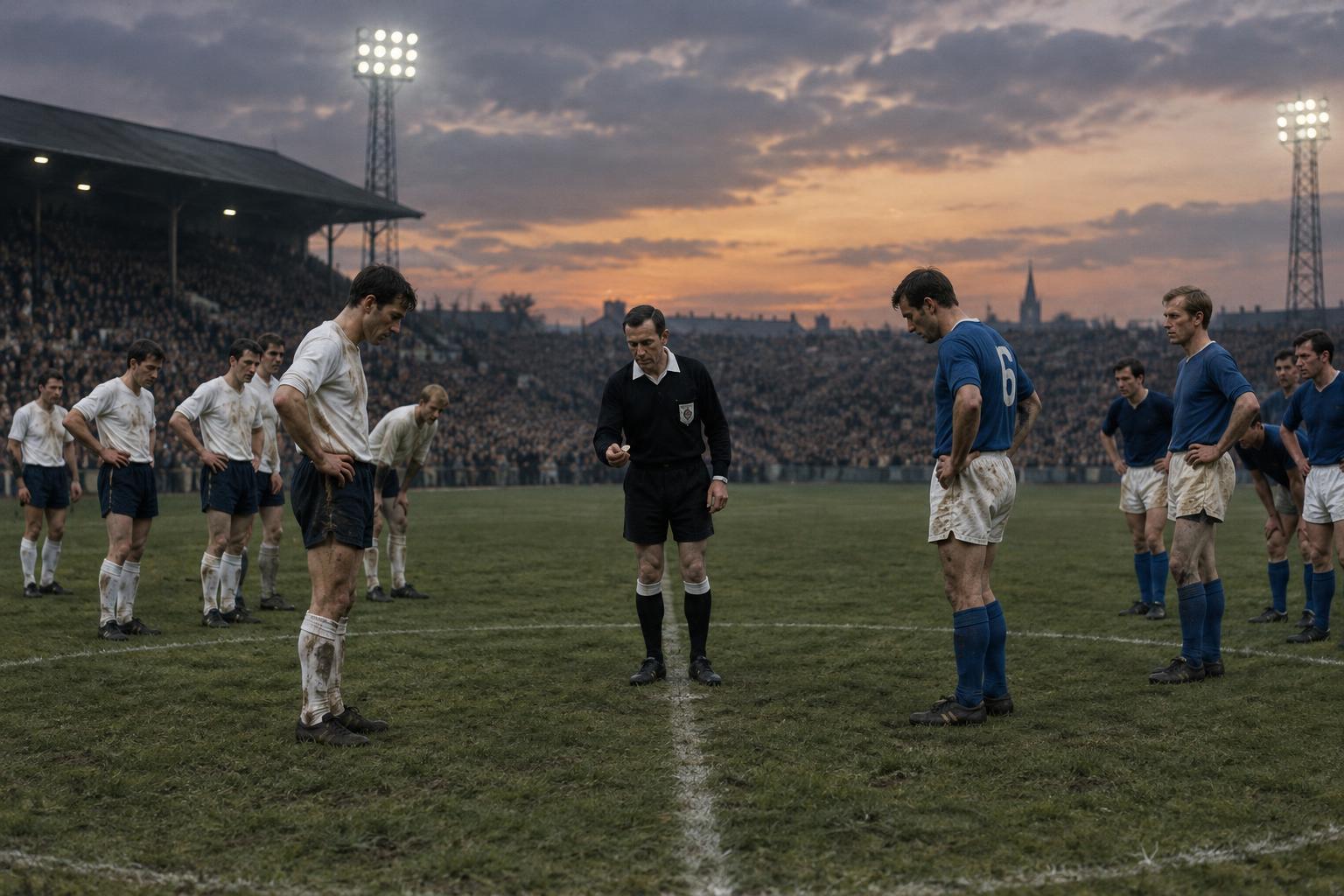
The first European Championship, then called the European Nations Cup, looked little like the competition familiar to travelling supporters today. Its early rounds were knockout ties played over two legs, with teams facing each other home and away. Winners advanced until four sides remained for a compact final stage. There was no long league table to follow and no qualifying group in which a slow start could be repaired several matches later.
That structure suited a competition with relatively few entrants. It also made the draw especially important: one difficult opponent could end a campaign before a team had met many of its continental neighbours. For supporters, qualification was a series of individual ties rather than a recurring itinerary of group-stage away trips.
Groups made qualification a campaign
As participation broadened, a purely knockout route became less useful. From the late 1960s, qualifying groups gave teams multiple opponents and a series of fixtures spread across a campaign. Group winners could then progress to further knockout rounds before the four-team final stage. The change did not immediately make the finals large; it changed how teams reached them.
A group format gave each entrant more matches and reduced the chance that a single bad evening would settle everything. It also created a different rhythm for fans: standings to check, return fixtures to anticipate and several possible away destinations. Not every group campaign was forgiving, however. When only the winner advanced, dropping points could still be costly.
Bigger finals meant more qualifying places
The final stage expanded from four teams to eight in 1980, and later to 16 in 1996. Each expansion changed the arithmetic of qualifying. More teams could reach the tournament, but organisers still needed a way to sort a substantial field of entrants through groups. Hosts generally received an automatic place in editions with a single host, leaving the other places to be won through qualifying.
The move to 16 finalists was particularly noticeable. Finishing first was no longer the only realistic route from every group: runners-up could also qualify or remain in contention, depending on that edition’s rules. That made second place meaningful in a way it had not always been. It also meant that supporters following another group’s results sometimes had a reason to care about a match far from their own team’s fixtures.
More entrants, more routes
European football’s map changed substantially around the early 1990s, as new national teams began entering UEFA competitions. Over time, the qualifying field became larger and more varied. Expansion of the finals helped accommodate that field: the tournament grew to 24 teams in 2016, creating more available places without removing the pressure of qualification.
Play-offs became an important way to allocate some of those places. Their exact rules have varied, so it is worth distinguishing the broad idea from any one tournament’s format. A team might qualify directly through its group, while another might get a final chance through a separate play-off. A larger final stage did not make qualifying simple; it gave more teams a plausible path and added outcomes to follow near the end of a campaign.
Why the format still matters to supporters
More recent qualifying systems show how far the competition has moved from its knockout beginnings. For the 2020 edition, matches were staged across multiple host countries, with no host receiving an automatic finals place. Nations League results also helped determine access to play-offs. For the 2024 edition, group qualification supplied most of the field, while further places were decided through play-offs linked to the Nations League.
For anyone looking back at a particular campaign, the safest approach is to check that edition’s rules rather than assume today’s route applied in the past. Ask how many teams reached the finals, whether a host qualified automatically, how many group places were available and what role any play-offs played. Those details explain both the stakes of a fixture and the journeys supporters made to see it. The enduring change is clear: as more nations entered, qualifying grew from a brief knockout contest into a broader football calendar.