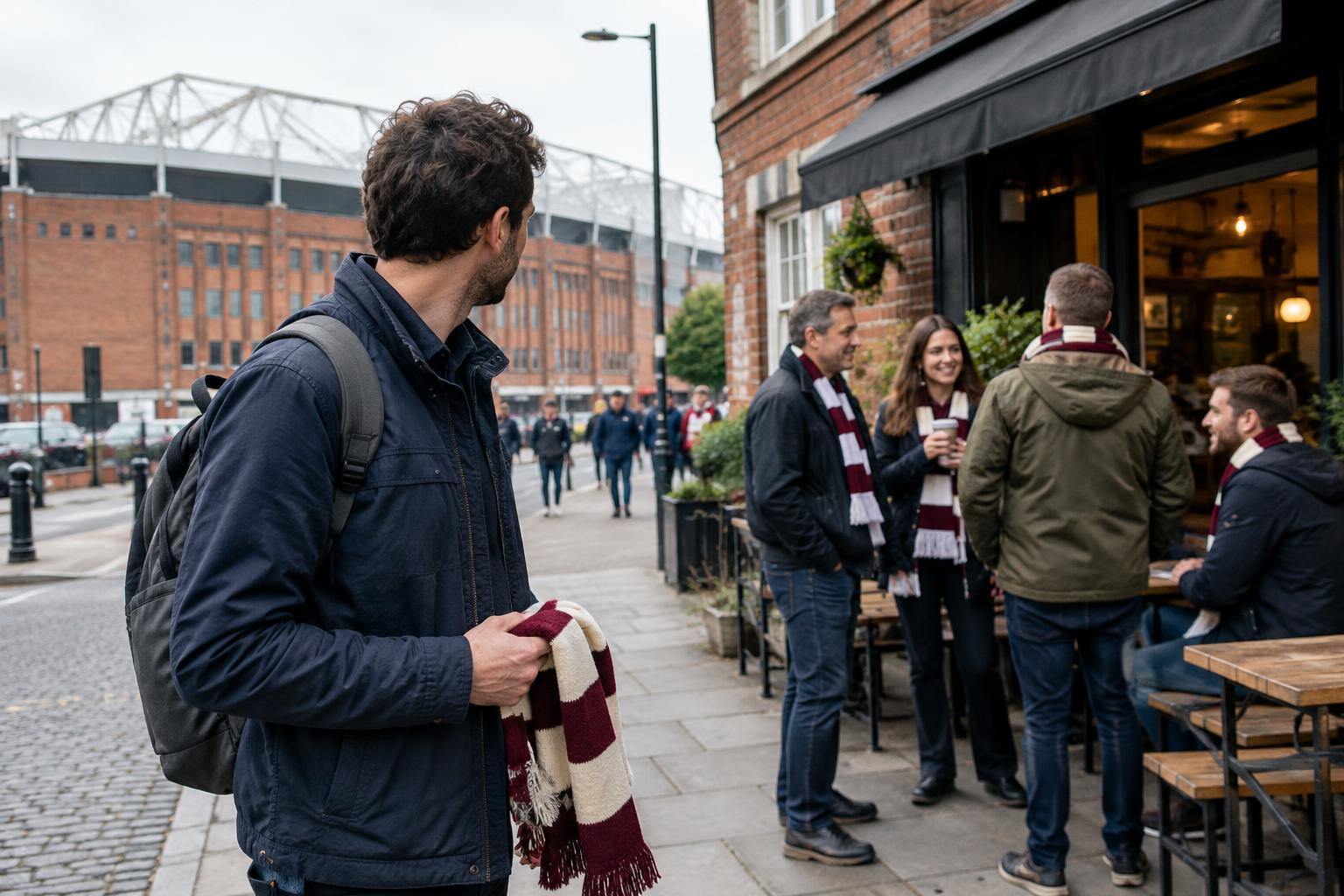
What your colors say before you speak
A football shirt is more than a travel outfit. It can start a conversation on a train, help fellow supporters find one another and turn a café stop into a discussion about memorable matches. A scarf is especially easy to carry and, on a cool evening, genuinely useful. For a visitor, wearing colors can be a way to take part in the occasion rather than merely watch it.
Colors can also communicate an allegiance you did not intend to emphasize. People may read an old shirt, a borrowed scarf or a design chosen for its looks as a declaration of support. That does not mean you should leave your kit at home. It means treating it as a choice suited to a particular place and moment, not as something you must wear from breakfast until bedtime.
Where a scarf can open doors
Around a match, colors often feel natural in spaces where supporters have gathered: a pre-match meeting place, a stadium approach used by your fellow fans or a venue showing the game. A scarf can offer an easy opening for a friendly exchange. If someone asks about your club, a little curiosity about theirs usually goes further than an argument about whose side is bigger.
Even in welcoming spaces, follow the lead of the people around you. A neighborhood café may be full of matchgoers one hour and families having dinner the next. Keep chants and celebrations to settings where they are welcome, and remember that wearing a shirt does not give you a claim on anyone’s time or attention. The best supporter encounters tend to begin with respect, not a performance.
When discretion is the more comfortable option
Derbies, intense rivalries and crowded journeys can change the feel of an otherwise ordinary trip. If you are passing through an area where another club’s supporters are gathering, or travelling alone after a match, a neutral jacket over your shirt may help you move through without inviting unwanted attention. This is a practical adjustment, not a judgment about a city or its fans.
Be especially thoughtful on public transport and in unfamiliar bars. A carriage packed with one group of supporters may not be the place to display opposing colors, even if you have no intention of provoking anyone. If a situation feels tense, avoid trading insults, taking close-up photos of people or trying to prove that you have a right to be there. Give others space and change your route or venue if that feels sensible.
Read the setting before choosing your outfit
Before match day, find out whether the ground has designated sections for home and visiting supporters and check the venue’s guidance on entry and clothing. Rules and arrangements vary, so do not assume that a shirt welcome in one section will be appropriate in another. If you have a seat among home supporters, consider whether visibly supporting the away side would be unwelcome or contrary to the venue’s instructions.
Ask straightforward questions when you are unsure: a host, venue worker or local supporter may be able to explain which route or gathering place suits your plans. Listen without expecting one person to speak for an entire fanbase. Conditions can shift as crowds arrive and disperse, so pay attention to what is happening around you rather than relying only on a plan made earlier.
Pack for choice, not for a fixed persona
You do not need a complicated wardrobe to travel thoughtfully. A shirt, a scarf and an unbranded outer layer give you options. The outer layer is useful for weather as well as for quieter moments, such as a museum visit or a late journey back to your accommodation. Keep a small bag or pocket free if you want to put a scarf away; check any stadium bag rules before setting off.
You can still show enthusiasm without wearing colors everywhere. Learn a little about the club and its neighborhood, arrive with time to spare, and be courteous to staff and other supporters. Wear your shirt when it adds to the shared occasion. Cover it when you would rather blend in. Neither choice makes you less of a fan: travelling well means knowing that the match is only one part of the place you have come to visit.